
ASME GD&T Vs ISO GPS
If you work in engineering or manufacturing industry, you know that “perfect” parts don’t exist. Real parts vary. To control this variation, we use symbolic languages on our drawings.
The two biggest “languages” in the world are ASME GD&T (American Society of Mechanical Engineers) and ISO GPS (Geometrical Product Specification).
While they look similar—often using the same symbols like Position ($\phi$) or Flatness ($\square$)—they follow very different rules. Mixing them up can lead to expensive manufacturing errors.

The Core Philosophy
Think of these standards as two different operating systems, like Windows and macOS. They both help you run a computer, but the underlying code is different.
ASME offers two major levels:
The Big Divide: Rule #1 vs. Independence
1. The ASME Approach (The Envelope Principle)
ASME uses Rule #1, also known as the Envelope Principle.8
In simple terms, Size controls Form.
If you have a pin with a diameter of 10 mm, and the tolerance is $\pm$ 0.1 mm, the maximum size is 10.1 mm. Under ASME rules, if that pin is produced at exactly 10.1 mm, it must be perfectly straight. It cannot be bent, or it won’t fit into a 10.1 mm hole. The “size” creates a perfect boundary (envelope) that the part must not cross.9
Example:
- Drawing: Pin diameter 10 $\pm$ 0.1.
ASME Meaning: At the largest size (10.1), the pin must be perfectly straight. You get straightness control for free!
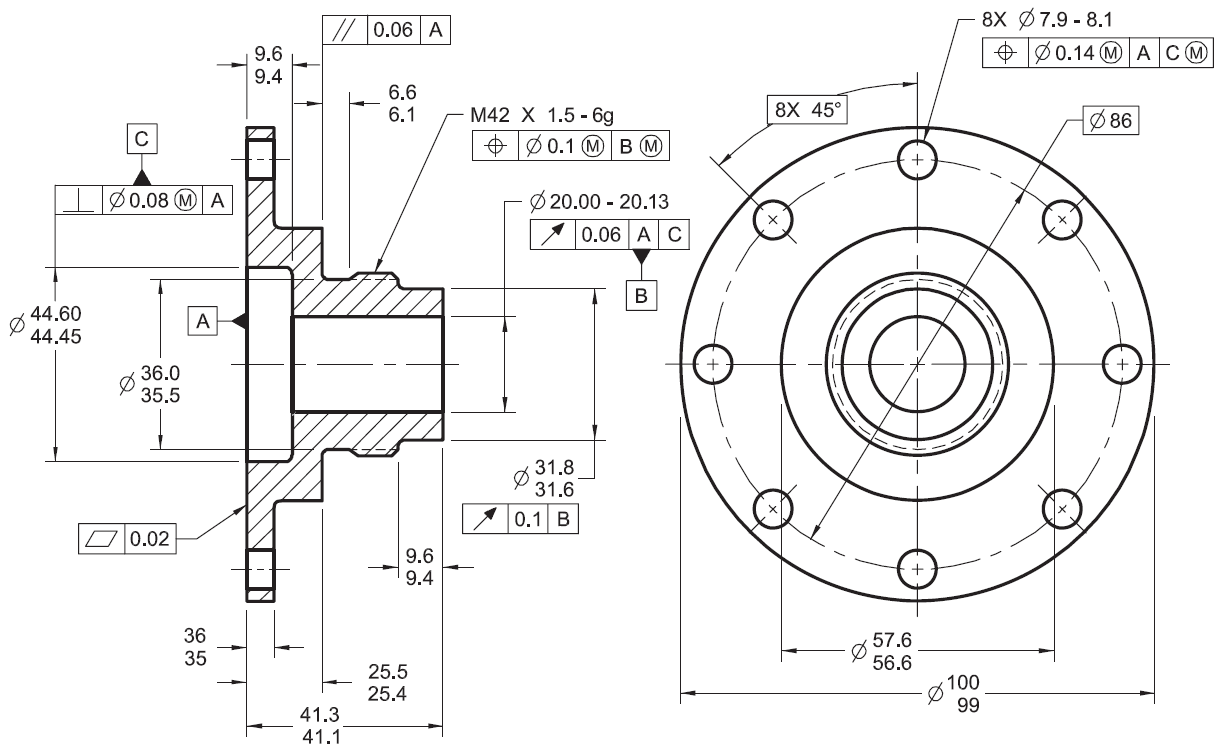
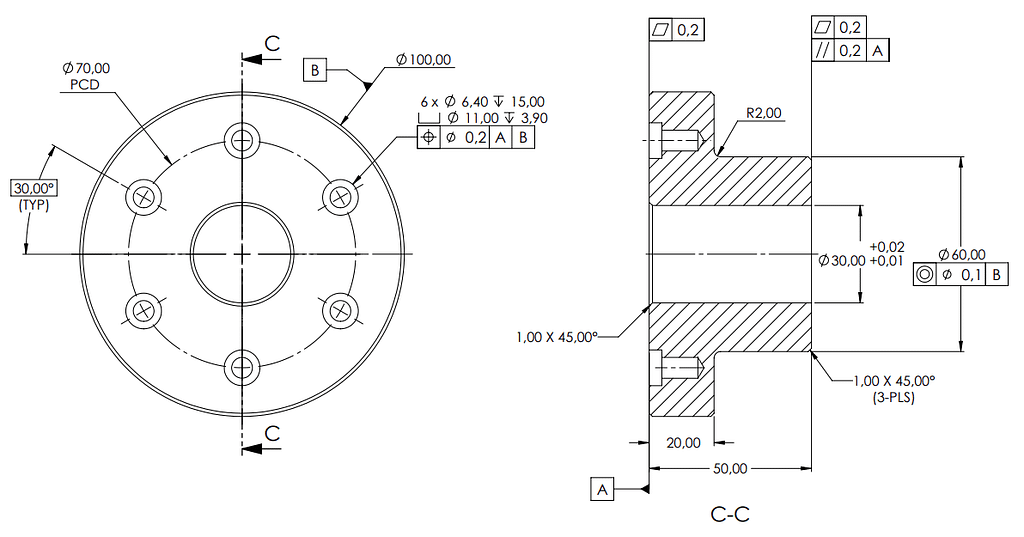
2. The ISO Approach (The Independence Principle)
ISO defaults to the Independence Principle (defined in ISO 8015).
In simple terms, Size and Form are separate.
If you have that same 10 mm pin in the ISO system, the diameter check is independent of the straightness check. You could have a pin that measures 10.1 mm in diameter but is bent like a banana. As long as the cross-section measures 10.1, it passes the size check, even if it doesn’t fit in the hole.
To get the same protection as ASME, you must explicitly add an (E) symbol (the Envelope symbol) next to the dimension.
Symbols: Same Look, Different Meaning
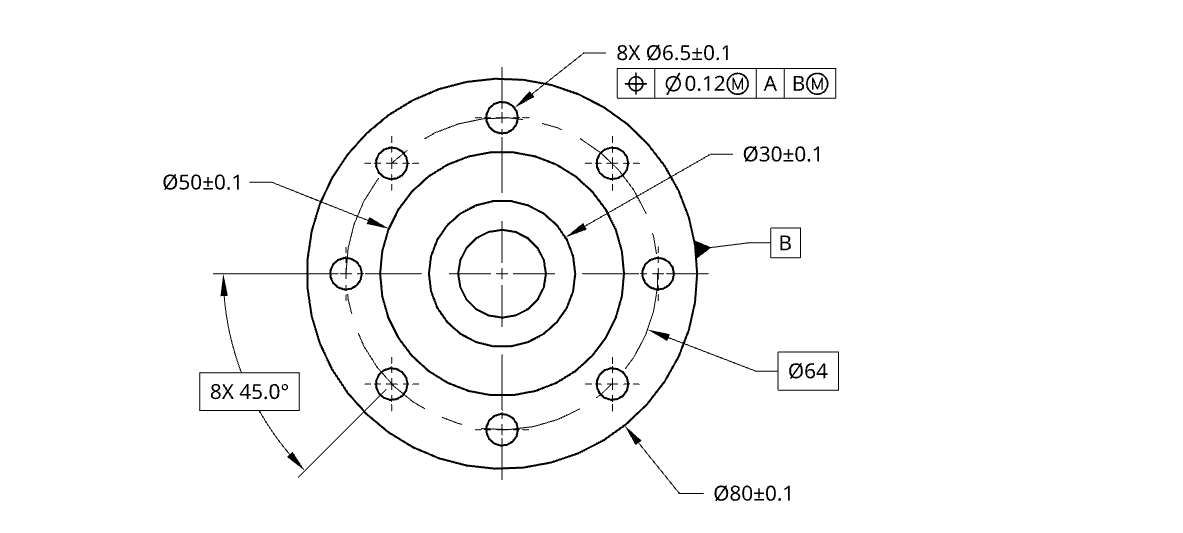
While many symbols are shared, some have changed or are interpreted differently.
Theoretical Exact Dimension (TED) vs. Basic Dimension:
In ASME, a boxed dimension (e.g., [25]) is called a Basic Dimension. In ISO, it is called a TED (Theoretically Exact Dimension). They mean roughly the same thing (exact location), but the names differ.
Concentricity and Symmetry:
- ASME: In the latest 2018 standard, the symbols for Concentricity and Symmetry were removed completely. They were considered too difficult to measure reliably.
- ISO: These symbols are still valid and commonly used.
Position Tolerance:
In ISO, if you have a pattern of holes (e.g., “4x holes”), the position tolerance might apply to each hole individually unless you add specific modifiers like “CZ” (Combined Zone). In ASME, the framework often implies they are a pattern automatically.
A Practical Scenario: The "Bent Pin"
If the drawing is ASME:
The part is likely REJECTED. The bend makes the “effective” size too big to fit the mating envelope. The standard protects the assembly.
If the drawing is ISO (default):
The part is ACCEPTED. The diameter is fine. The bend is fine (because no separate straightness tolerance was specified). If you try to assemble this, it might jam.